Antenna Design and Optimization
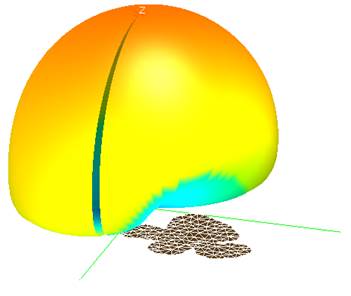 Numerous medical
devices are implanted in the body for medical use. These include pacemakers and
defibrillators, hormone pumps, nerve stimulators, and more. With the
advancement and miniaturization of bio-electronics it is likely that the array
of implantable medical devices will continue to expand in the years to come.
Medical implants are intended to stay in the body for many years or decades,
and it is often necessary to communicate with the device to download data about
the health of the device or its batteries or the health of the patient, or to
upload changes in settings or new procedures specified by the doctor. It is
even conceivable that the patient could control the setting of his or her
medical implant with the touch of a button from a wireless device.
Numerous medical
devices are implanted in the body for medical use. These include pacemakers and
defibrillators, hormone pumps, nerve stimulators, and more. With the
advancement and miniaturization of bio-electronics it is likely that the array
of implantable medical devices will continue to expand in the years to come.
Medical implants are intended to stay in the body for many years or decades,
and it is often necessary to communicate with the device to download data about
the health of the device or its batteries or the health of the patient, or to
upload changes in settings or new procedures specified by the doctor. It is
even conceivable that the patient could control the setting of his or her
medical implant with the touch of a button from a wireless device.
The
design of antennas that can communicate with implantable devices is an
interesting and challenging problem. The antenna must be small and long-term
biocompatible, preferably able to be mounted on existing implant hardware or to
utilize part of the hardware itself. The antenna must be electrically insulated
from the body so as not to short out and be ineffective, and it must be
efficient so as not to excessively drain the batteries. It must not exceed the
safety guidelines for power deposited in the body, and should be insensitive to
external EM noise. Some applications (such as data up or down load) could use a
high-gain directional system, whereas other applications (such as monitoring
while the patient is mobile and active) would require a more isotropic system.
For some cases (such as nerve stimulators) it is possible that the implanted
antenna for communication could also be used for sensing the electrical
properties of the tissue in the surrounding region, which might be used to
provide biologically-relevant information about the health of the patient.
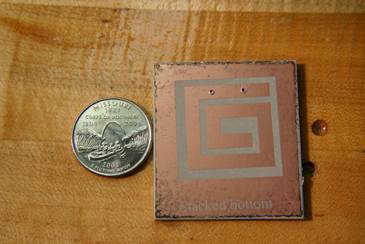
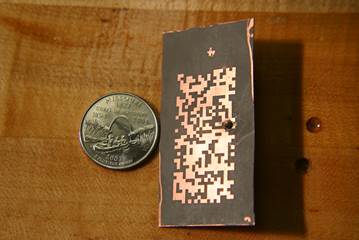 Some of the most successful designs have been the
spiral, serpentine, or genetic-algorithm waffle-type
designs.
Some of the most successful designs have been the
spiral, serpentine, or genetic-algorithm waffle-type
designs.
Other
applications of the genetic algorithm antenna design software are multi-band
designs (such as the one shown top left), broad band designs, or antennas for
specialty applications.
Thank you to our Sponsors:
National
Science Foundation
Blackrock
Microsystems
Disclaimer: This material is presented to ensure timely dissemination of
scholarly and technical work. Copyright and all rights therein are retained by
authors or by other copyright holders. All persons copying this information are
expected to adhere to the terms and constraints invoked by each author's
copyright. In most cases, these works may not be reposted without the explicit
permission of the copyright holder. For IEEE material: Personal use of this material
is permitted. However, permission to reprint/republish this material for
advertising or promotional purposes or for creating new collective works for
resale or redistribution to servers or lists, or to reuse any copyrighted
component of this work in other works must be obtained from the IEEE.
Overviews
(INVITED PAPER) C.Furse, A Survey of Phased Arrays for Medical Applications, ACES Journal, Special Issue on Phased Arrays
, Vol. 21, No.3, Nov 2006, pp.365-379
O.P. Gandhi, C.M.Furse, G. Lazzi, Monopole Antennas
, Wiley Encyclopedia of Electrical and Electronics Engineering,
John Webster, editor, 2000; Reprinted in Wiley Encyclopedia of RF and
Microwave Engineering, 2003, Vol 4, pp.
3238-3244
C.M.Furse, O.P. Gandhi, G. Lazzi, Dipole Antennas , Wiley Encyclopedia of Electrical and
Electronics Engineering, John Webster, editor, 2000, 2006 (online);
Reprinted in Wiley Encyclopedia of RF and Microwave Engineering, 2003, Vol 2, pp. 1047-1052
C.M. Furse, G. Lazzi, O.P. Gandhi, Dipole, Monopole and Loop
Antennas, Modern Antennas, Constantine Balanis,
editor, 2006
C.M.Furse, Antennas for Medical
Applications, Antenna Engineering Handbook, John Volakis, editor, 2006
Implantable Antennas for Medical Applications
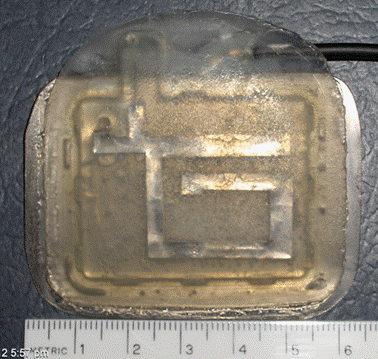
M. Rodriguez, R. Franklin, C. Furse, Manufacturing Considerations for
Implantable Antennas, 2013 IEEE AP-S International Symposium on Antennas and Propagation and
2012 USNC/CNC/URSI Meeting in Lake Buena Vista, FLA, July 7-12, 2013
C.Furse, Design of an Antenna for
Pacemaker Communication, Microwaves and RF, March 2000, p. 73-76
P. Soontornpipit, C.M. Furse, and Y.C. Chung , “Design of Implantable Microstrip
Antenna for Communication with Medical Implants,” Special Issue of IEEE Transactions on Microwave Theory and
Techniques on Medical Applications and Biological Effects of RF/Microwaves
, Vol. 52, No. 8 Part 2, Sept. 2004, pp. 1944-1951
Nano-Crescent
Antennas
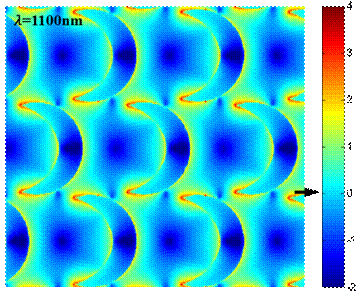
Miguel Rodriguez, Cynthia Furse,
Jennifer Shumaker-Parry, Steve Blair, Scaling the Response of Nano-Crescents
into the Ultraviolet, ACS Photonics, 1 (6), pp 496-506, 2014
Transparent
Antennas
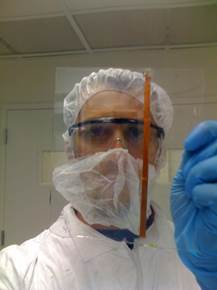
J. Saberin, C. Furse, Challenges with Optically Transparent Patch
Antennas, Invited paper IEEE Antennas and Propagation Magazine, Vol. 53. No. 3 pp. 10-16
and No. 4 pp. 118-119, March 2012
3D
Printed Antennas
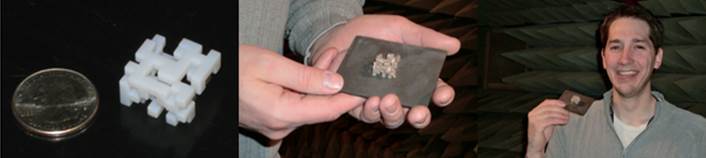
B. Willis, C. Furse, A Look at the Future of Printed Antennas,2012
IEEE AP-S International Symposium on Antennas and Propagation and 2012
USNC/CNC/URSI Meeting in Chicago, Illinois, July 8-14, 2012
Multiple
Input Multiple Output (MIMO)
Sai Ananthanarayanan P.R.,
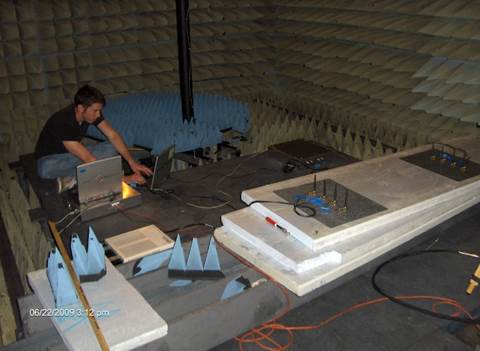
Alyssa Magleby Richards, Cynthia Furse, Measurement
and Modeling of Multi-user Multi-antenna system in aircraft in the presence of
electromagnetic noise and interference, Microwave
and Optical Technology Letters, Volume 53, Issue 5, pages 1137-1144, May
2011
Sai Ananthanarayanan P.R., Alyssa Magleby
Richards, Cynthia Furse, Measurement and modeling of Multi-Antenna Systems in
Small Aircraft, Journal of Aerospace Computing, Information, and
Communication, June 2011, Vol.
8: 170-182.
Sai Ananthanarayanan P.R., Alyssa Magleby, James R. Nagel, Cynthia Furse, Measurement and
modeling of Interference for multiple antenna system, Microwave and Optical Technology Letters, Vol. 51, No. 9, pp.
2031-2037, June 2010
(invited
paper) J. Nagel, A. Magleby, S. Ananthanarayanan, C.
Furse, Measured Multi-User MIMO Capacity in Aircraft, IEEE Antennas and Propagation Magazine, 52(4), Aug 2010, 179-184
D.
Landon, C. Furse, MIMO Capacity Dependence on Realistic Cross-Polarization and
Branch-Power-Ratios, Microwave and
Optical Technology Letters, Vol 50, No. 5, May 2008, pp. 1384-1388
David G. Landon, Cynthia M. Furse, Recovering handset diversity and MIMO capacity with
polarization-agile antennas, IEEE Trans.
Antennas and Propagation, Volume 55, Issue 11, Part 2, Nov. 2007
Page(s):3333-3340
MRI
Coil Design
Down-Borehole
Loops for Geophysical Imaging
D.Johnson, C.Furse, A.Tripp, FDTD Modeling and Validation of
EM Survey Tools, Microwave and Optical Technology Letters, Sept. 20, 2002
D.Johnson, E.Cherkaev, C.Furse, A.Tripp, Cross-Borehole Delineation of a
Conductive Ore Deposit -- Experimental Design, Geophysics, May/June 2001
D.Johnson, C.Furse, A.Tripp, PML for FDTD Modeling of a
Conductive Ore Deposit in a Lossy Dielectric, Microwave and Optical Technology Letters, Vol. 25, No.4, May 20,
2000, pp. 253-255
C.M. Furse, D.M. Johnson, A.C. Tripp, Application of the FDTD
Method to Geophysical Simulations, Applied
Computational Electromagnetics Society Newsletter, March 1999
BroadBand and MultiBand Designs
Soil Moisture Antenna
Pichitpong Soontornpipit, Cynthia M. Furse, You Chung Chung, and Bryan M. Lin, Optimization
of a Buried Microstrip Antenna for Simultaneous Communication and Sensing of Soil
Moisture, IEEE Trans. AP Special Issue on
Antenna Applications, Volume 54, Issue 3, March
2006 Page(s):797 - 800
Antennas in Plasma
J. Ward, C. Swenson,C.Furse, The Impedance of a Short Dipole Antenna in a Magnetized Plasma
via a FDTD model, IEEE Trans. Antennas
and Propagation, Vol 53, No8, Aug 2005, pp. 2711-2718